Peer-reviewed research and regulatory documents our medical team consults when evaluating intake for this protocol.
Science (AAAS)
NAD+ in aging, metabolism, and neurodegeneration
Landmark review establishing that cellular NAD+ concentrations decline with age and that NAD+ precursor supplementation has therapeutic potential for age-related and neurodegenerative disease.
Verdin E — Science 2015
View source
Trends in Cell Biology (Cell Press)
NAD+ and sirtuins in aging and disease
Foundational review explaining how NAD+ decline drives sirtuin dysfunction and contributes to mitochondrial and nuclear defects underlying age-associated disease.
Imai S, Guarente L — Trends in Cell Biology 2014
View source
Cell Metabolism (Cell Press)
Therapeutic Potential of NAD-Boosting Molecules: The In Vivo Evidence
Comprehensive review of in vivo evidence for NAD-boosting molecules (including NR and NMN) across cardiovascular, metabolic, neurodegenerative, and longevity endpoints in animal models.
Rajman L, Chwalek K, Sinclair DA — Cell Metabolism 2018
View source
Nature Communications (Springer Nature)
Chronic nicotinamide riboside supplementation is well-tolerated and elevates NAD+ in healthy middle-aged and older adults
Randomized, double-blind, placebo-controlled crossover trial in 24 healthy adults 55-79: 1,000 mg/day oral nicotinamide riboside for 6 weeks was well tolerated and raised whole-blood NAD+ approximately 60%.
Martens CR, Denman BA, Mazzo MR, Armstrong ML, Reisdorph N, McQueen MB, Chonchol M, Seals DR — Nature Communications 2018
View source
Nature Communications (Springer Nature)
First-in-human study: oral nicotinamide riboside raises blood NAD+
First-in-human pharmacokinetic study of oral nicotinamide riboside (100, 300, 1,000 mg) demonstrating dose-dependent elevation of the blood NAD+ metabolome.
Trammell SAJ, Schmidt MS, Weidemann BJ, Redpath P, Jaksch F, Dellinger RW, Li Z, Abel ED, Migaud ME, Brenner C — Nature Communications 2016
View source
Endocrine Journal (Japan Endocrine Society)
Effect of oral administration of nicotinamide mononucleotide on clinical parameters and nicotinamide metabolite levels in healthy Japanese men
First published human safety study of oral NMN (single doses of 100, 250, and 500 mg in 10 healthy men): no significant adverse effects, with dose-dependent rises in downstream NAD+ metabolites.
Irie J, Inagaki E, Fujita M, Nakaya H, Mitsuishi M, Yamaguchi S, Yamashita K, et al. — Endocrine Journal 2020
View source
Frontiers in Aging Neuroscience
A Pilot Study Investigating Changes in the Human Plasma and Urine NAD+ Metabolome During a 6 Hour Intravenous Infusion of NAD+
Small pilot study (n=11 men) of IV NAD+ (750 mg over 6 hours) — among the only peer-reviewed pharmacokinetic data on injectable NAD+ in humans. Found NAD+ was rapidly cleared from plasma with measurable changes in downstream metabolites. Authors note clinical evidence base for IV NAD+ remains limited.
Grant R, Berg J, Mestayer R, Braidy N, Bennett J, Broom S, Watson J — Frontiers in Aging Neuroscience 2019
View source
American Journal of Physiology - Endocrinology and Metabolism
Evaluation of safety and effectiveness of NAD in different clinical conditions: a systematic review
Systematic review of 10 RCTs (489 participants) on NAD and NADH supplementation. Generally well tolerated; common side effects included muscle pain, sleep disturbance, and headache. Authors flag heterogeneity and limited high-quality efficacy data.
Gindri IM, Ferrari G, Pinto LPS, Bicca J, Dos Santos IK, Dallacosta D, Roesler CRM — American Journal of Physiology - Endocrinology and Metabolism 2024
View source
U.S. Pharmacopeial Convention
USP General Chapter <797> Pharmaceutical Compounding - Sterile Preparations
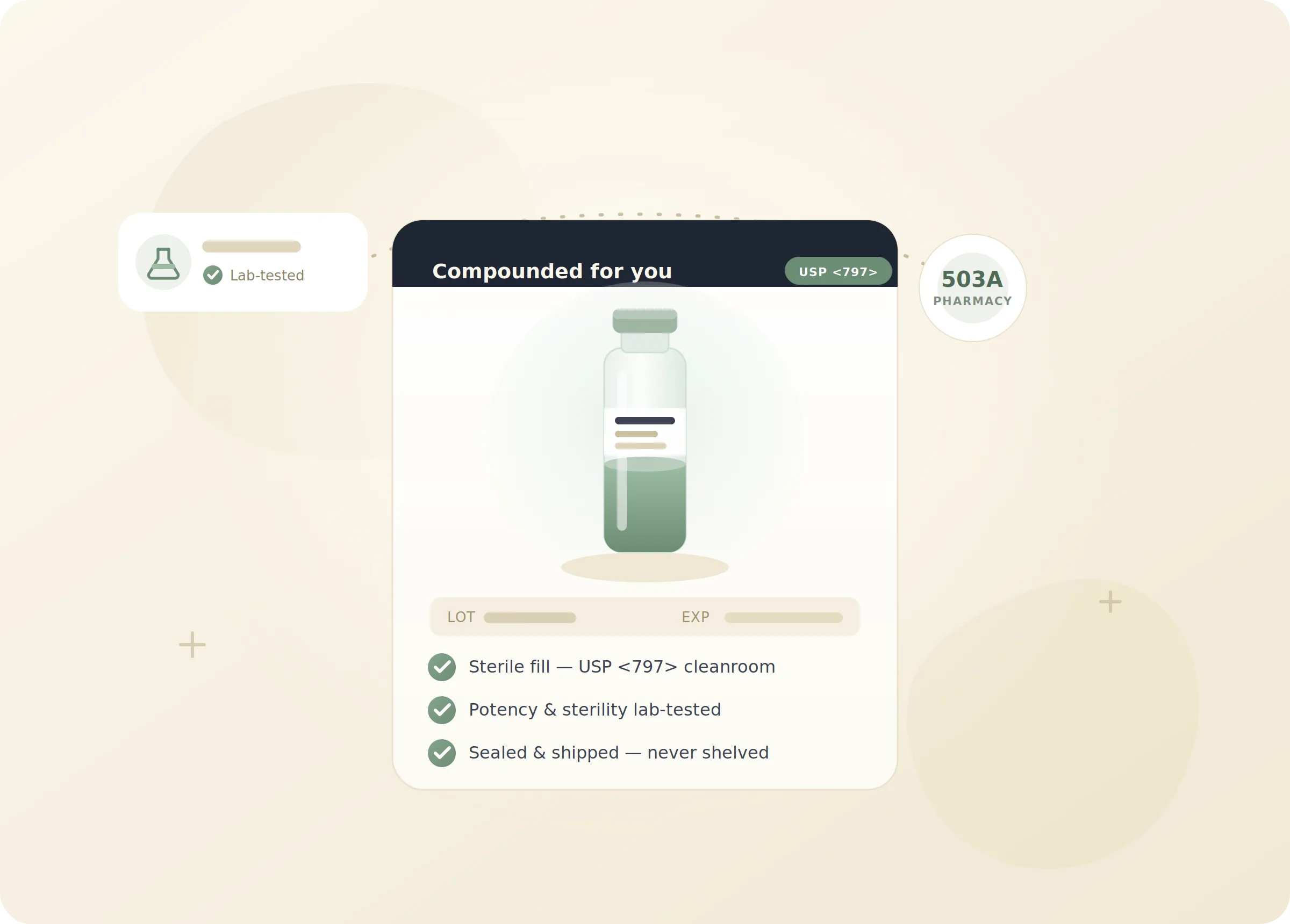
Official enforceable U.S. standard for sterile compounding (effective November 1, 2023). Governs facilities, personnel training, environmental monitoring, and beyond-use dating for all sterile compounded preparations including injectable NAD+.
2023
View source
U.S. National Institutes of Health - National Library of Medicine
ClinicalTrials.gov - U.S. registry of clinical research studies
Public registry of clinical trials. Searchable for active and completed NAD+, NR, and NMN studies. Useful for current trial status; injectable NAD+ trials remain limited compared to oral precursor studies.
2026
View source
U.S. Government Publishing Office - Electronic Code of Federal Regulations
21 CFR Part 216 - Human Drug Compounding
Federal regulatory framework governing human drug compounding, including conditions under which licensed pharmacies (503A) may compound preparations using bulk drug substances.
2026
View source
U.S. Food and Drug Administration
Interim Policy on Compounding Using Bulk Drug Substances Under Section 503A of the Federal Food, Drug, and Cosmetic Act; Guidance for Industry (2024)
FDA's January 2025 final guidance on interim policy for bulk drug substances used by 503A pharmacies. Important context: FDA has historically proposed NOT to include NAD on the formal 503A Bulks List, and NADH (reduced form) has been placed in Category 2 (significant safety risks). 503A pharmacies that compound NAD+ do so under FDA enforcement discretion, not under an affirmative FDA endorsement of safety/efficacy.
2025
View source
Nuvari Clinical Note
Evidence-base caveat for injectable NAD+
The mechanism literature on NAD+ in aging and metabolism is well established (Verdin 2015, Imai & Guarente 2014, Rajman et al. 2018). Human clinical efficacy data for oral NAD precursors (NR, NMN) is growing but still early-stage (Martens 2018, Trammell 2016, Irie 2020). Rigorous human clinical trial data specifically on injectable NAD+ remains limited — the Grant 2019 pilot (n=11) is one of the few peer-reviewed sources, and the Gindri 2024 systematic review notes heterogeneity and low-quality evidence. NAD+ is not FDA-approved for therapeutic use; compounded preparations are dispensed under 503A enforcement discretion. Nuvari's copy reflects this uncertainty.
Nuvari, 2026